The Brosnan era of Bond films seems to get criticized purely because of how bad his final outing was in Die Another Die. Nothing else can explain it, because his other three films are really terrific entries to the series. Today I am looking at Tomorrow Never Dies. This one is often overlooked, considering it is sandwiched between the excellent Goldeneye and polarizing The World is not Enough. Also working against it is that unlike those two, TND did not have a memorable video game adaptation (just a much maligned PS1 game I never owned). Just as TWINE has received somewhat of a retrospective re-ranking among fans and casuals alike, so too has Tomorrow Never Dies gotten a second look (especially amid Michelle Yeoh’s resurgence). So where does it fall in my retrospective and subjective ranking of Bond films?
Editor’s note: I have been through 16 Bond films, and as a massive fan of the series I have noticed a bit of a pattern: similar 7/10 ratings throughout. In order to differentiate these titles with a similar rating, I will be employing a head to head showdown between films in the final ranking with both a tier list and ordered ranking. Anyways, that’s a little over a week away…
Setting & Story
Setting
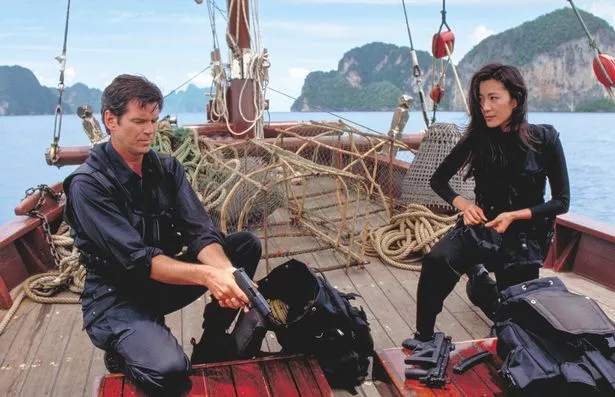
Outside Carver’s media headquarters in Hamburg, most of our film is set in East Asia. We get some excellent action sequences making full use of their setting, including the motorcycle chase over the rooftops in Thailand. In terms of lair, we get Eliot Carver’s stealth boat, clearly modeled after the B2 stealth-bomber. As impressive as the exterior is (along with some outstanding model/miniature work) the interior is rather forgettable and generic. Eliot’s headquarters in Hamburg are framed as futuristic, and cutting edge technology. However much like the Bond films of the 60s this villain lair feels very much a product of its era, with its CRT monitors, early bioinformatic scanners and glossy chrome trim everywhere— I’m just waiting for the Moby score to drop or perhaps some Britpop might be more appropriate… As we make our way to the third act climax, Bond and Wai Lin take us to the White Lotus for some island paradise shots, all very nice.
So where does the setting rank in this one? Well it’s just about average. Neither especially memorable, nor with any unique attributes it’s not the standout of this film. With lairs that fail to live up to their exteriors promise, it can feel even a bit bland at times. 6/10.
Story
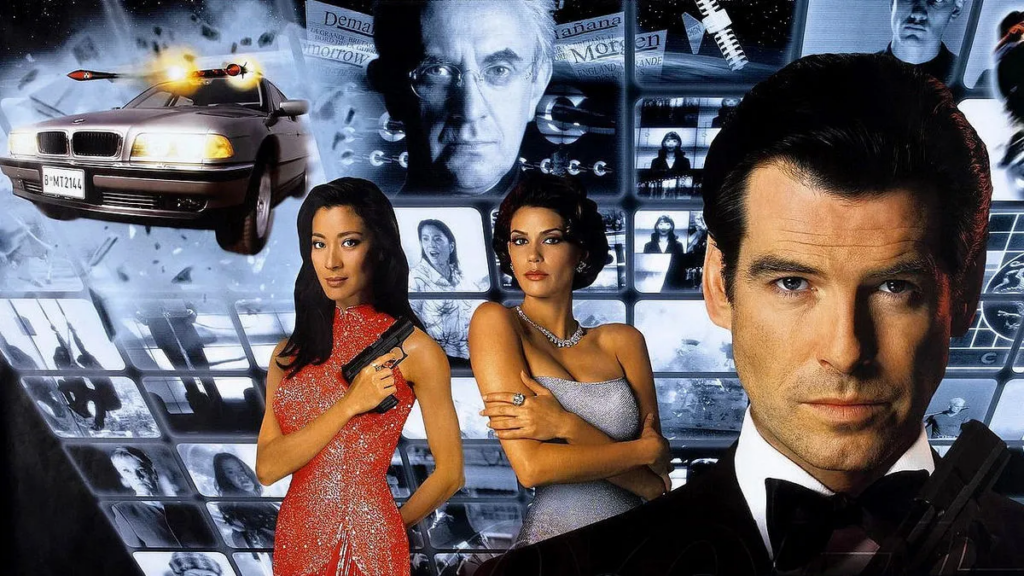
The Brosnan Bond films can often feel like oracles for the 21st century to come. In TWINE we have a terrorist attempting to intervene in the world’s oil supply. In Goldeneye we see the power vacuum of the Soviet Union’s collapse result in daring betrayals and inside attacks. And in Tomorrow Never Dies we see a media baron manipulate the world with his media empire. Sure these films may not be one for one predictions, but they get their themes mostly right. TWINE pre-dates the wars which would be fought over oil in the early 21st century along with the pipeline drama of the 2010s. Goldeneye captures the political gamesmanship of post-Soviet power struggles and the rise of oligarchs. The apartment bombings across Russia in 1999 led to the second Chechen war and is frequently cited by Western intelligence agencies as a potential false flag, just as Servenaya was an inside attack in the film. Now we have Eliot Carver giving us Bond’s take on Succession, which is itself based on the “fake news” empire of Rupert Murdoch.
Our story begins in the caucasus mountains at a terrorism bazaar where just about everything, including warheads, are for sale. It’s a terrific opener, with one of my favorite Brosnan quips (“backseat driver”). Most importantly however is one singular buyer here: Gupta. He is a tech-nerd turned terrorist for hire. He acquires a satellite control system. For what purpose? Eliot Carver, media baron and owner of Carver News Group and its worldwide brand of news channels and papers, is scheming to create news of his own. He has set up a confrontation between China and the United Kingdom, resulting in the downing of one Chinese MIG and an entire UK destroyer. How does Carver do this? He has Gupta cause positioning issues via satellite, which consequently sets up a territorial conflict between East and West. Then, using a stealth boat, he launches a cutting-probe to saw into the battleship in order to steal its missiles after sinking it. After he dispatches with the ship, he fires another missile to take down the MIG. Now East and West want answers before heading to WWIII. Bond is sent to investigate after M convinces cooler heads to prevail (at least for 48H). Something isn’t adding up, and what is points to Eliot, who seemed to be in possession of impossible information, and whose satellites were in the area of the attack. Bond uncovers Eliot’s operation with the help of an old flame. His Chinese counterpart, Wai Lin, is also investigating the media baron at the same party. After crossing paths a few times and getting in each other’s way, they team up to conclusively prove his involvement in the false flag attack. To what end though? Eliot reveals that his plan is to re-establish world order, taking out Beijing in an attack, thus allowing his faceless partner in crime, General Chang to assume control of China, call for peace, and in return grant him a century of exclusive broadcasting rights in the reclusive nation. It’s a very expensive plan, for an uncertain payoff (we’’ll get to that), but of course Bond and Wai Lin foil it. They board the stealth boat, reveal its location to the British, and warn their governments of the real enemy before he and his allies are all killed. Guess we’ll have to stick to CNN.
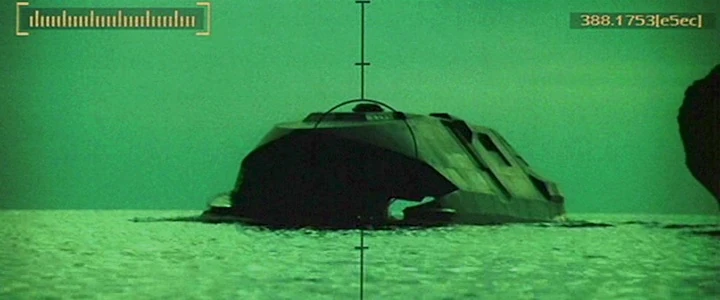
It’s a fascinating idea for a Bond plot which holds a lot of relevance in today’s day and age where so much of our media is prone to manipulation. However it is the scale of Eliot’s scheme that I take issue with. In order to provoke WWIII to grab some headlines and gain control over a reclusive nation’s broadcasting rights, he would have had to invest at minimum BILLIONS of dollars to:
1. invent/launch a world-first stealth boat using Chinese technology.
2. Develop and build a saw-probe and weapon for launch.
3. Secure satellite controls at black market weapons expo.
4. Pay Gupta to secure this control and also to carry out your plan.
5. Staff and run an entire stealth boat operation well enough to avoid leaks of your plan.
6. Equip stealth boat with missiles worth tens of millions of dollars.
7. Use your own $300m satellite to produce interference.
8. Have enough disposable billions to still launch your international media empire’s new satellite news program.
I know Rupert Murdoch is cartoonishly wealthy thanks to his empire of yellow journalism, but not even he could pull this off. Even the richest man in the world, Elon Musk, would have to sell more than a few cybertrucks to pull off this stunt. While fans may point to Blofeld and his billion dollar space programs, I would counter that by saying he is part of SPECTRE, which is an entire international organization working towards common goals. In this film Carver is seemingly a one-man operation, we don’t even get to see a board. It’s a major contrivance to believe the scale of this operation is even remotely plausible or even worth it for what he is after (Chinese broadcasting rights). However, that’s just me splitting hairs because although it’s not believable, it also doesn’t take me out of the story either. I just roll with it as high fantasy, because in spite of its incredulity, the film otherwise explains itself well and unlike Skyfall or Octopussy there are no sloppy plot holes.
So where does this setting and story rank overall? I think the premise of this film is outstanding even if it could have been more realistically executed. We get some fantastic collaboration between Bond and Wai Lin and a memorable villain with contemporary relevance in Eliot Carver. Overall I think this film is narratively well crafted in spite of its less than memorable settings which earns it a strong 7/10.
Gadgets and Vehicles
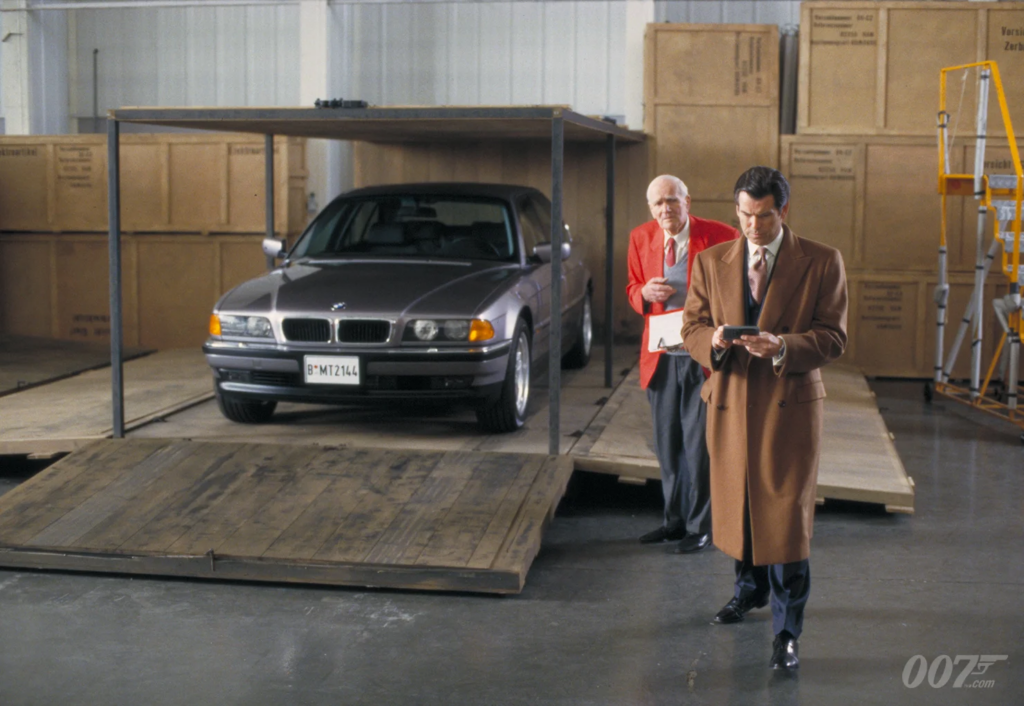
We get some clever gadgetry via Bond’s cellphone here; a universal key, an electronic stun, and a finger-print scanner, all of which get their chance to shine during the mission. We get bonus gadgets here too, getting to see Wai Lin’s version of Q branch in a wonderful scene between Yeoh and Brosnan.
But it’s the vehicle which elevates this category to iconic. I think you could argue that outside the original DB5 chase in Goldfinger, this is the most iconic outing for a Bond vehicle of all time. The remote control BMW 750i is not only a nifty invention, it’s given us one of the most memorable Bond action set-pieces of the entire franchise. Did I add that it’s virtually indestructible?
What makes the Brosnan era so enjoyable apart from the actor’s ability to perfectly blend comedy with action (arguably even better than Roger Moore) are the scenes with Q branch. We get such memorable exchanges between Brosnan’s Bond and Llewellyn’s Q for his final three films. That is no exception here where we meet Q in the field, dressed as an Avis rental car agent to introduce Bond to our new vehicle. I absolutely love that he manages to “return” the car to Q via the Avis rental car window, after the 7-series is launched from the roof of the hotel car-park.
Without question, this category earns a 10/10. That’s three perfect gadget/vehicle scores for the Brosnan era.
Action Sequences
While the film does tend to rely a lot on vehicle action in between fisticuffs, all of the direction is superb and memorable. Vehicle chases can often feel boring or even drawn out (Live and Let Die boat chase for example). It can be hard to balance the second unit portion of action with inserted character moments which still keeps the audience engaged in the story (something TWINE struggles with under the direction of Michael Apted). Tomorrow Never Dies does not have this problem.
Let’s unpack the film’s approach to action with the famous car-park remote control chase scene.
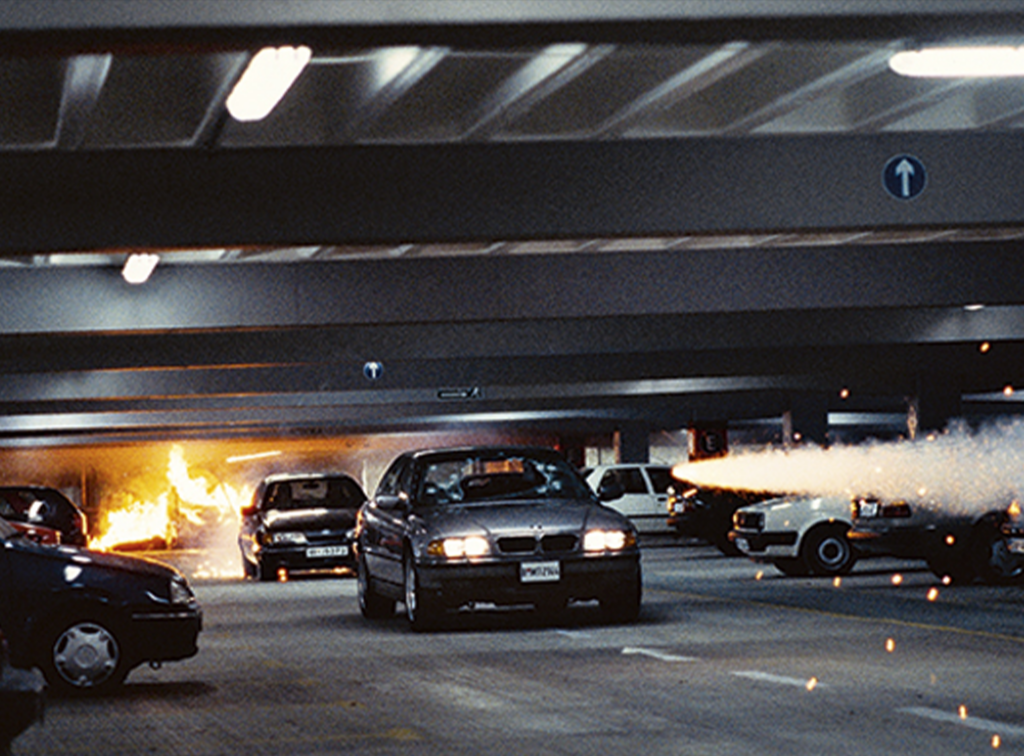
This scene is actually a continuation of Bond’s escape from the Carver headquarters, which is itself an action scene featuring both Bond getting physical in fights and being creative to escape a hail of gunfire. Speaking of fights, after watching a bunch of 60s and 70s Bond films, it’s nice to see punches land realistic damage. In the 70s, a simple smack on the back was enough to knock out most henchmen. In 1997, Brosnan Bond really had to earn his KO’s…
Anyways, Bond escapes to the car park (or parking garage since we here in America like to muck up the English language the same way we avoid the metric system). He activates the remote control, jumps in the back and makes his way towards the exit amid more gunfire. The car begins warning him of his operation, adding more humor to the mix. The car’s voice reminds me of Siri in the modern era, always interrupting at the most inopportune moments. I am pretty sure that I tell Siri to shut up more than I ever ask her questions. That said, Bond also ignores his voice assistant and drives through henchmen, takes a missile through the windshield and cuts through a tension cord with our BMW-badge revealing a saw at just the perfect height to avoid turning this 7-series executive car into a convertible. The mix between Brosnan in the back seat figuring out all the goodies on his remote control is good immersive use of inserts that keeps us with our protagonist. Meanwhile the henchmen positioning new obstacles around the garage add an element of tension and suspense as we wonder how Bond is going to get out of this one. Ultimately we see him use the control again to subvert expectations, escaping out the back seat and launching it around the ramp up to the top, luring the henchmen in pursuit as he flies it off the building and returns it to Avis, no doubt to a disappointed Q. Absolute perfection.
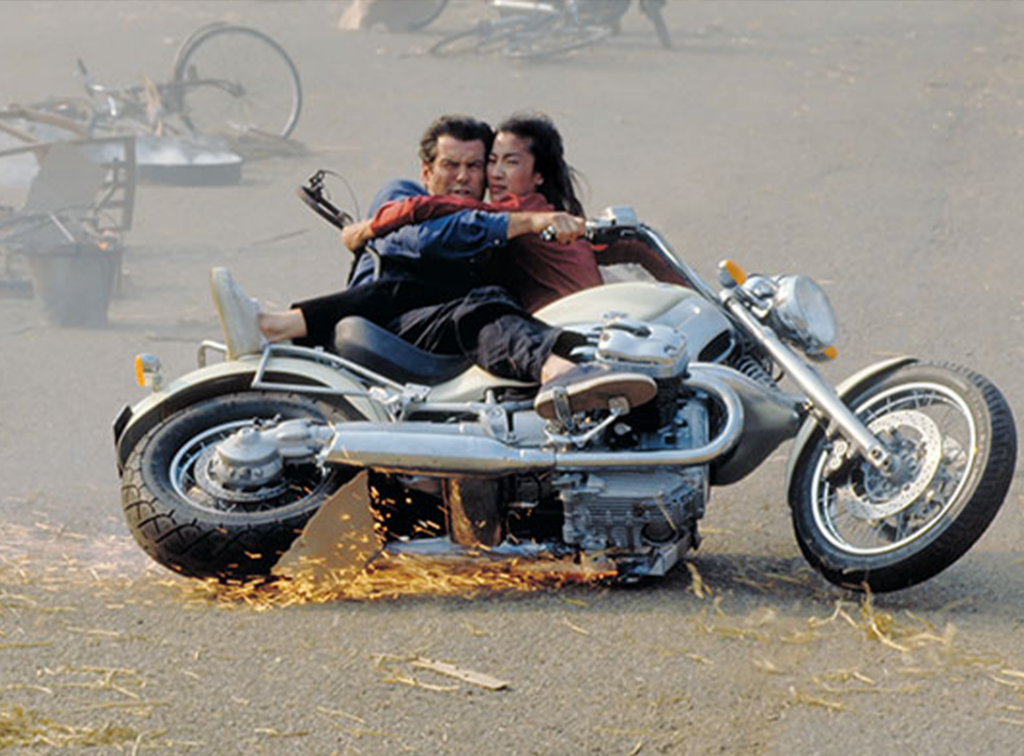
There are other great moments throughout this film as well, making good on the Bond action formula:
- Elaborate action set pieces
- Add elements of humor
- Provide Bond opportunities to be creative in escape/perseverance especially through the use of Q branch equipment
The Brosnan era perfects this formula in the same way the Craig films sought to entirely abandon it. It’s why action set-pieces in 90s Bond films stand out; the tank chase in Goldeneye, the car-park chase here, the boat chase pre-credits sequence in TWINE… they are all series standouts. Now tell me one Craig era action set-piece that arises to a series standout? I’ll wait……. You can’t because they abandoned the Bond formula to replicate every other action series of the era. I don’t even want to hear about that rooftop chase in Casino Royale, Ethan Hunt has done much the same thing.
The action here is on par with Goldeneye, earning a rare 10/10 for its perfection of the Bond action formula.
Villain & Bond Girls
Villains

Our primary villain here is a very convincing one, played with appropriate conviction by the always excellent Jonathan Pryce. He is entirely convincing in his role as a media baron determined to not only rule the world but to control it. His character at once blends the traditional megalomaniac Bond-villain template with more modern sensibilities grounded in appropriate cultural critique. While his plan may be a bit ostentatious, if not outrageously unbelievable, Pryce is so effective he sells us on all of it. He may lack the defining attributes of a more physical villain, or even the cruel cunning of some of our other rogue geniuses, but he is grounded in a way that feels believable. You can see the influences of Rupert Murdoch or today, Elon Musk, in Eliot Carver. For that I rate him quite highly. 8/10.
Carver’s henchman Mr. Stamper feels like a retread of numerous blonde baddies throughout the franchise down to his vaguely German accent. He’s not especially memorable or intriguing, nor is there much to set him apart from those who came before him, from Red Grant to Necros. 3/10 for being so unimaginative.
Honorable mention?
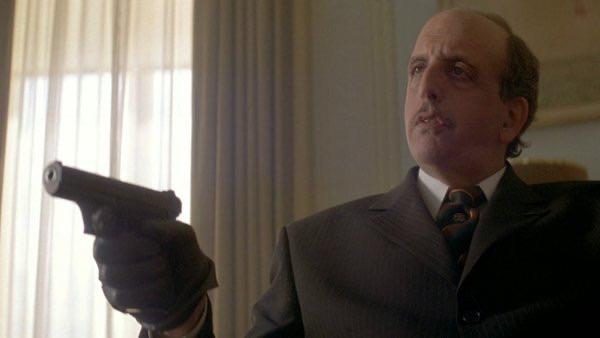
I only wish we got more of Vicent Schiavelli as Dr. Kaufman. While he is only in the single scene in the hotel room, where he is sent to kill Bond following the murder of Paris Carver, he absolutely steals the entire scene. He is humorous without necessarily intending to be, and his dry and exacting personality is what creates such a memorable exchange between him and Bond. He feels like a Bond villain of old, and even his demise at the hands of Bond produces a classic exchange: Kaufman, pleading for his life, “please I am only a professional doing a job,” to which Bond coldly replies, “me too,” as he pulls the trigger execution style. 10/10 henchman.
Bond Girls
We get two Bond girls here, both are helpful to our hero.
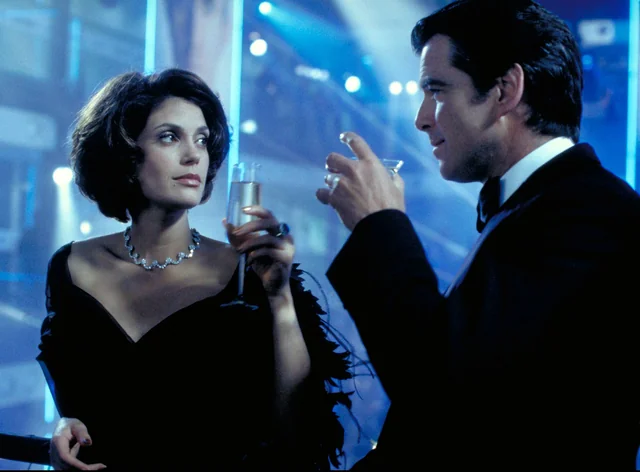
First up we get Paris Carver, Eliot’s wife and former flame of 007 himself. Played by Teri Hatcher, she falls pray to many of the same criticisms against American Bond girls: not exotic enough. She feels a bit pedestrian and while she is certainly attractive, she feels almost motherly and a bit too old for the part. You can imagine Paris Carver pulling up to Harvard-Westlake school in 1997 Los Angeles, driving her M-class Mercedes, Starbucks cup sitting in the cup holder while Enya plays to calm her down on the way back up to Topanga canyon for morning yoga. Anyways perhaps you get the picture, she’s just not the look the series should have settled on. For that reason, I never really buy her relationship with Bond and she exits the film almost as soon as she enters it. 4/10.

Our next Bond girl has had a bit of a career resurgence lately, even winning an Oscar for the incredible Everything, Everywhere, All at Once. Michelle Yeoh is absolutely kick-ass (literally) in this outing as Chinese agent Wai Lin. While she may not rank among the hottest of all time, she makes up for it with the most convincing and memorable female secret agent sidekicks of the franchise. I recall the producers wanting to make a spinoff film for Halle Barry’s Jinx character. Forget that! We should have had one with Wai Lin. She’s truly Bond’s equal in ways that no other Bond girl even up to the present has been. While you may argue Anya Amasova in The Spy Who Loved Me, I’d argue Wai Lin is leagues above her abilities. She is one of my favorites in the series. 9/10.
Overall this category earns a stellar, but not perfect, 7/10. It drops down from near perfection due to one of the more lackluster Bond girls of the franchise and a derivative henchman.
Wildcard!
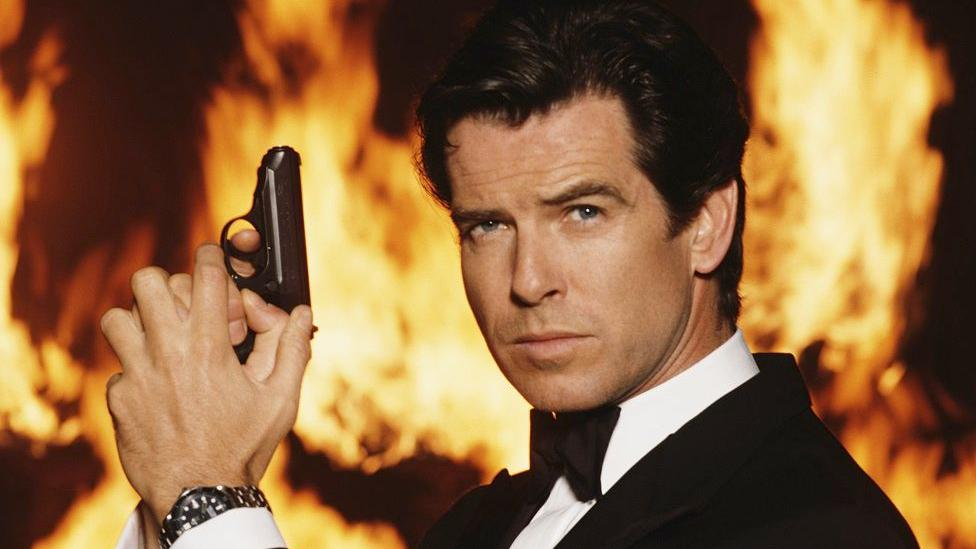
I am so glad to have rewatched this film again after many years. It’s so easy to ignore it among the more prominent films in the timeline around it. Brosnan’s outing as Bond really helped to save this franchise. For all the flack it has gotten since, I am glad to see his era getting some newfound respect from critics and fans alike. I know I haven’t gotten to Die Another Die yet, but 3/4 solid entries is still a good era overall. I feel like Brosnan perfected the balance between suave action star and humorous wit core to the Bond cinematic experience. He is the nostalgic essence of Bond for an entire generation. Just as Connery became iconic for Boomers, and Moore for Gen-X, Brosnan is the Millennium Bond and he helped usher this franchise into modern times. I think he deserves more credit than what he has gotten to date. No wild card rating here, just wanted to take the opportunity to wax nostalgic a bit and defend my favorite era of the franchise. I strongly suspect 3/4 Brosnan outings will make my subjective top ten.
Conclusion
Tomorrow Never Dies is a sophomore outing that fails to fall prey to that often dubious distinction. It’s a terrific action film and Bond outing that truly holds up even decades later. When I was younger, this one didn’t stand out to me as one I necessarily desired to revisit. Just as some other titles (Skyfall, Live & Let Die) have fallen down my ranking as I have matured, this one has dramatically climbed. It’s really a very underrated film, and I give it a strong 8/10 overall, tying its successor TWINE for that extremely high subjective rating.
Discover more from MK Leibman Writer
Subscribe to get the latest posts sent to your email.