Say whatever you want about the debates which continue to rage over what the best film is, who was the best Bond etc. One of the most enduring fan discussions actually relates to Bond’s romances. Notably, did he ever actually love any of these women on screen, and if so, is it even possible to fall in love given the relatively short time spent together?
Before I dive into this debate, I wanted to start by differentiating love and lust. Unlike lust, which comes on hot and heavy and burns intensely in that moment, love is a fire which never really dies. Love is forever, such that once you’ve felt it for someone, you will always love that person. Even if you find yourself falling out of love, either because you have changed, they have changed, the dynamic has changed, the love you felt for that past likewise never dies.
But what about the time needed to fall in love? This is often a criticism of the series, where fans say they don’t feel convinced because of the improbability of the time spent together. Love isn’t logical. There’s no hard and fast rule, where you spend X amount of time with someone, getting to know them before it happens. Sometimes love can also strike based on idealism, and a sort of fantastical impression. Yet, the love isn’t any less real in spite of that.
Now I haven’t finished my rewatch of the series yet, so I am going to reserve judgment on some of the more hotly debated Bond “loves,” such as Madeleine Swan (SPECTRE, No Time to Die) or definite “loves” like Vesper (Casino Royale) and instead focus on another controversial “love” in a film I did recently get a chance to rewatch: The World is Not Enough. I will use Bond’s complicated relationship with villain Elektra King to explore the themes of Bond as someone vulnerable enough to fall in love. You can then take this reasoning and apply it to other cases as a critical comparison.
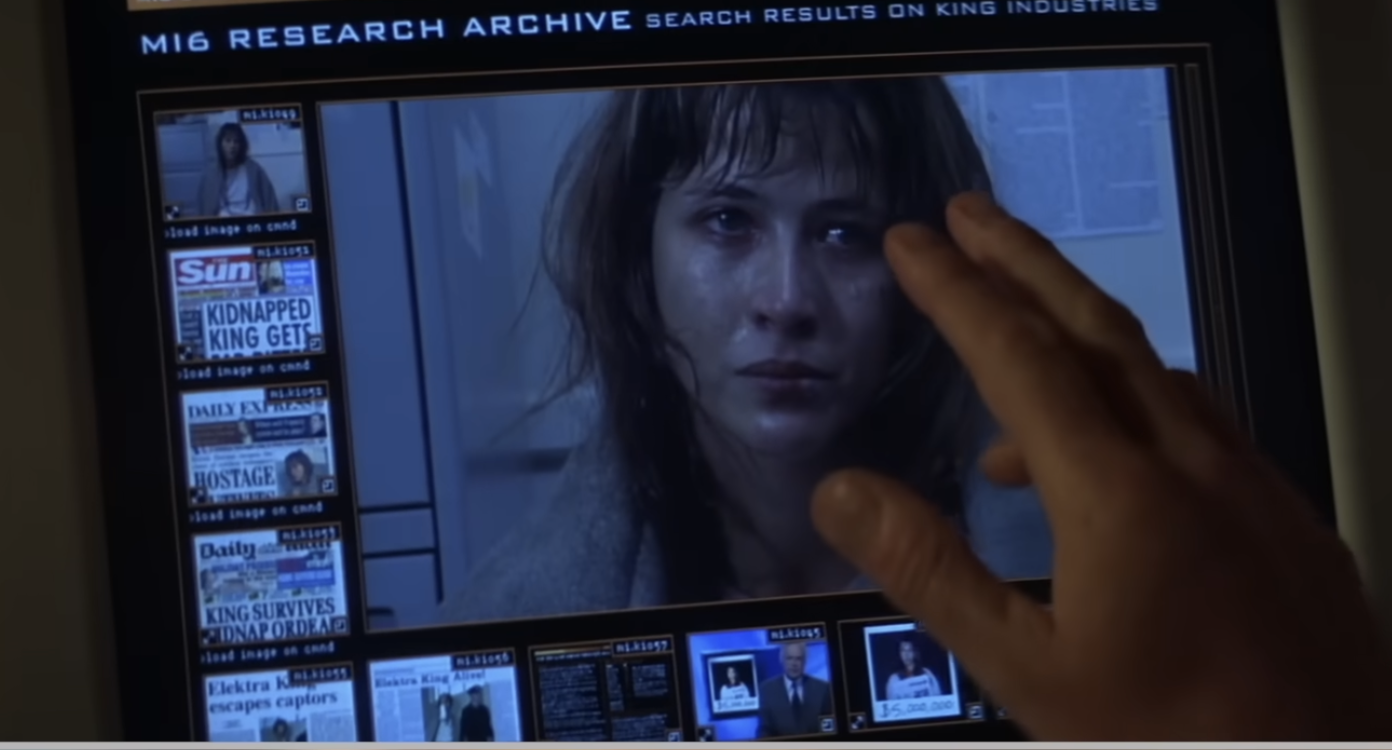
Let’s start by unpacking the first glimpse of sentiment we see between Bond and King. Bond is doing some casework and comes across a video where Elektra recounts her escape from decades in imprisonment. Before he has even met her in person (he’s seen her of course) he has demonstrated empathy for her. He strokes the computer screen, as if to wipe away her tears. Now of all the women in the series, why demonstrate empathy here? I mean, Bond is not exactly known for such empathy, so what about this relationship brings that out in him? I’d argue it’s an extension of her slain father’s relationship with M. M failed to protect her, and while at this point we have yet to get M’s side of the story, Bond is already drawn to her plight because of this association. In a way, she is MI6 family, or at the very least, a family friend. This elevates her in this regard beyond any number of random women Bond encounters in the field.
It’s also deeper than that when we reflect upon what I said above regarding love forming as a result of idealism in the way we ascribe certain fantastical traits to people we may become attracted to. Love can absolutely form based on the way we perceive someone, including people we don’t know especially well. We have just enough of an idealism for the feelings to take hold when coupled with deep, enduring lustful attraction. Elektra really exposes her vulnerability in this video that Bond watches, it’s a very compelling act and one that hooks Bond in. While I don’t think Bond is yet in love here, what this scene intends to do is show that the seeds are indeed planted. Bond is devoted to mission, and although the failure to protect Elektra did not happen on his watch, he nonetheless must feel for her given MI6’s failure.
When Bond finally speaks to M about the case, wanting to course correct and protect her in a way MI6 no longer could, it becomes a personal mission for him. We see M share how badly she feels, even invoking her instincts as a mother, when sharing her grief over what happened. Seeing M show vulnerability ups the emotional stakes for Bond. He wants to be Elektra’s protector, a very natural instinct for most men.

After our thrilling ski chase where Elektra again demonstrates that same emotional vulnerability, trapped in Q’s bubble jacket amid an avalanche, we find ourselves returning to an important scene at her villa. It’s a brief but important evolution in the character’s relationship. This is a complex woman, who on the one hand demonstrates incredible vulnerability (playing off Bond’s guilt), but also a sort of fierce independence in the way she initially dismisses his concerns. She impresses him with her bit of diplomacy at the Church, but he is equally attracted to her obvious overt playfulness and flirtation. We get some of that here as well, when Elektra asks him to stay with her. But what she is really saying through subtext is protect me. She knows exactly how to manipulate Bond, it’s quite impressive! Where most Bonds would take full advantage of that in the moment, Bond here also knows that he is developing feelings and that gets messy. Out of respect for her, but also the mission, he declines and goes off to the casino. The choice not to sleep with her in that moment is a powerful bit of restraint that signals Bond is already viewing this woman differently. This is not just lust, but the dawn of very dangerous feelings that a field operative like him is ordinarily trained to avoid. Remember M at the outset of the mission: “remember 007, shadows stay in front or behind, never on top.”
Of course Elektra disobeys direct orders and turns up at the casino to drop what is a blatant transaction between her and Valentin. While this is not lost on Bond, he knows it is highly suspicious and perhaps the first inkling that this woman may or may not be who she says she is. “Elektra, this is a game I cannot afford to play,” he remarks. “I know,” Elektra responds, as if she knows the honey pot deal is sealed. Let’s unpack the subtext here because the flowery dialog leaves a bit more to be explored. Bond realizes he has fallen for this woman’s charm, but he also knows how dangerous that actually is. This is the first time he is willing to set his instincts as a spy aside to allow lust, and even potential love to cloud his better judgment.
They spend the night together, where Elektra also takes this opportunity to further seduce Bond into some emotional dialog to increase the success of her emotional high stakes game. Bond is just careful enough to not reveal much, but what is obvious now at this point is that he definitely has strong feelings for her. But love?

After fleeing the villa in the middle of the night to continue his mission, Bond finally confronts henchman Renard in the missile silo. At first, it’s typical Bond shoving the baddie up against a wall. But when Renard drops Elektra’s motto at gunpoint, we see Bond turn from mission professionalism to anger. Bond is angry to know Renard has corrupted this woman, essentially confirming his instincts were correct: Elektra is bad (more on that later). But why the anger response? I think the only thing which can explain this reaction is the deep feelings he held for her being turned upside down. His over the top physicality aimed at Renard is now personal. That level of anger in reaction to this is only possible if real feelings were there to begin with.
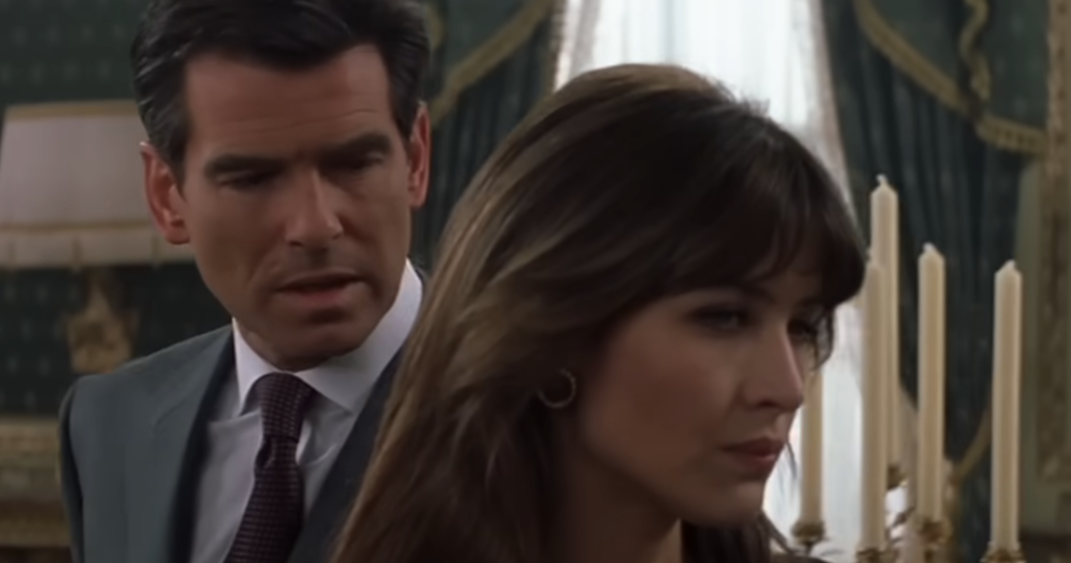
Bond returns to the villa to confront Elektra about her duplicity. He even offers Stockholm syndrome as an explanation, in a way preserving her innocence (he would rather say it is Renard behind her turning heel). When Elektra slaps him, offering up her version of plausible explanation for how Renard used certain words, or knew about his shoulder, we see Bond offer up a look of doubt. For a spy that has so heavily relied on instinct to keep him alive, we see his feelings for her clouding his better judgment in real time.
Let’s further unpack Bond’s explanation: Stockholm syndrome, or where a kidnap victim falls for their captor as a sort of mental self defense. In a way he offers this explanation to try and get her to snap out of Renard’s spell. He is offering her an out, to save her. He wants to save her from not only this man, but this ordeal. He is not even emotionally capable of considering the fact that she is the master manipulator behind it all. Of course, once she captures M and fleas to Instanbul, little doubt is left of her true nature.

I think it’s safe to say that Elektra, overconfident in her master manipulation even had a thing for Bond too. “If only you kept away, we might have met in a couple of years and become lovers once more,” she tells him before strapping him to a kinky torture device. I think a case can be made that she genuinely saw her plan succeeding, fooling Bond, and providing her the opportunity to have her cake and eat it too. There is emotional precedence for this as well when the bedroom scene with Renard shows a rather cold and disinterested Elektra. Through dialog exchanges between her and Renard we are meant to interpret this as her preference for her romance with James.
When the final showdown between the pair arrives at the top of Maiden’s Tower, Bond hesitates. If this were any other villain, he’d make some quip and do the deed he’s granted a license to kill for. However here Bond is almost pleading with her to call off the mission. He is pleading with her, not merely because he wishes to avert calamity, but because he wants to save her still. The exchange is tense, emotional, with Elektra even quipping, “you wouldn’t kill me, you’d miss me,” before immediately attempting to alert Renard. Bond shoots her in cold blood with visible anger, and in one of Brosnan’s coldest moments as Bond, he retorts: “I never miss.” From M’s perspective we see Bond consoling this awful decision he had to make, he caresses her forehead in a tender moment thinking again of the woman he arguably did love– even if that vision of her in his head was only ever fantasy. Ultimately she is a woman who he couldn’t save in spite of his best efforts.
****
I think there are very few moments where Bond does cross the line from lust into love, but I think the case can be made for Elektra (certainly also his wife, Tracy Bond and Vesper). The line is blurred because Bond abandons his better instincts, blinded by emotion. It doesn’t happen often throughout the series, but when it does, I think it gives us some of our best outings in the franchise. I’ll explore SPECTRE eventually, along with Madeleine Swan, as my retrospective reviews will continue through the end of the year. Until then, I hope this post can helpfully add to some fan debate.
Next up: reviewing Dalton’s outing as Bond in The Living Daylights and License to Kill (probably tomorrow based on how much work it’s taken to digest them properly). I’m having a ton of fun deep diving into my favorite cinematic franchise of all time. While I still have plenty of fiction work to do (& will get to it in 2026) this is a fun way to end the year.
Discover more from MK Leibman Writer
Subscribe to get the latest posts sent to your email.